
This Is Why NGOs Love IBS Management

Running a non-governmental organization is not like running a business. It is harder.
You answer to donors who each have their own reporting formats. You manage projects in remote communities where internet connectivity drops in and out. You operate with lean teams under intense public scrutiny. Every franc, shilling, and naira you spend must be justified — not just to your board, but to the communities you serve.
And then there is the software problem.
Most ERP systems were built for corporations chasing profit margins. They do not understand grant cycles, donor fund earmarking, or the fiduciary complexity of running three simultaneous projects funded by four different donors. They are bloated, expensive, and — frankly — built for someone else.
IBS Management was not. It was purpose-built for the operational realities of organizations that exist to create social change. Here is exactly why NGOs across East and Central Africa trust it to run their back office.
1. Grant & Project Budget Tracking — Real Control, Not Spreadsheet Chaos
The moment a grant lands, the clock starts. Donors want to see money move purposefully and accountably. The traditional approach — a maze of Excel files, manual journal entries, and emailed updates — is a recipe for audit failures and strained donor relationships.
IBS Management gives you a dedicated grant management module that treats each grant as its own financial universe:
- Project-specific P&L statements — know exactly what was spent on each grant, at any moment, without waiting for month-end.
- Budget vs. actuals tracking — see variance in real time. When you are 40% into spending but only 25% into project delivery, the system flags it immediately.
- Multi-grant consolidation — run five projects simultaneously with complete separation of funds, while generating a consolidated executive dashboard with a single click.
- Expenditure classification by donor category — because Donor A calls it "Programme Delivery" and Donor B calls it "Direct Field Activities." IBS handles both simultaneously.
For an organization managing millions in grant funding, this is not a nice-to-have. It is the difference between a clean audit and a funding withdrawal.
2. Donor Fund Allocation & Transparency — The Kind Donors Actually Verify
Donor confidence is earned slowly and lost in an instant. The most common way NGOs lose it? Poor fund visibility. A donor requests a midterm financial update, and it takes three days to pull the numbers together. IBS Management eliminates this entirely.
Every expenditure is tagged at the point of entry with its funding source. This means:
- Real-time donor fund dashboards — a live view of what percentage of each grant has been spent, on what, and what remains.
- Earmarked fund protection — funds allocated to specific project components cannot be accidentally reclassified or co-mingled.
- Instant donor reports — generate donor-specific financial summaries in seconds, formatted to their reporting standards.
- Full audit trail — every transaction, every approval, every amendment is timestamped and attributed to a named user. Nothing disappears.
When your donors can trust your numbers without having to verify them manually, funding relationships get longer and grant ceilings get higher.
3. Requisition Approval Workflows — No More Paper Chains
Field procurement is where NGO money leaks. A program officer in a remote district needs supplies. Without a structured system, they submit a handwritten request, someone physically signs it, another person processes the payment, and three people later it is impossible to trace what was bought, from whom, and against which budget line.
IBS Management replaces this paper chain with a digital requisition workflow:
- Staff submit purchase requisitions from their device — phone, tablet, laptop — anywhere.
- Requests automatically route to the appropriate approver based on value thresholds and department.
- Finance teams see the pending requisitions, verify budget availability in real time, and approve or flag with comments.
- Approved requisitions generate purchase orders automatically, linked to the correct budget line and grant code.
- Every step is logged, visible, and auditable.
The result: zero unauthorized purchases, zero lost paperwork, complete accountability from the field to the finance office.
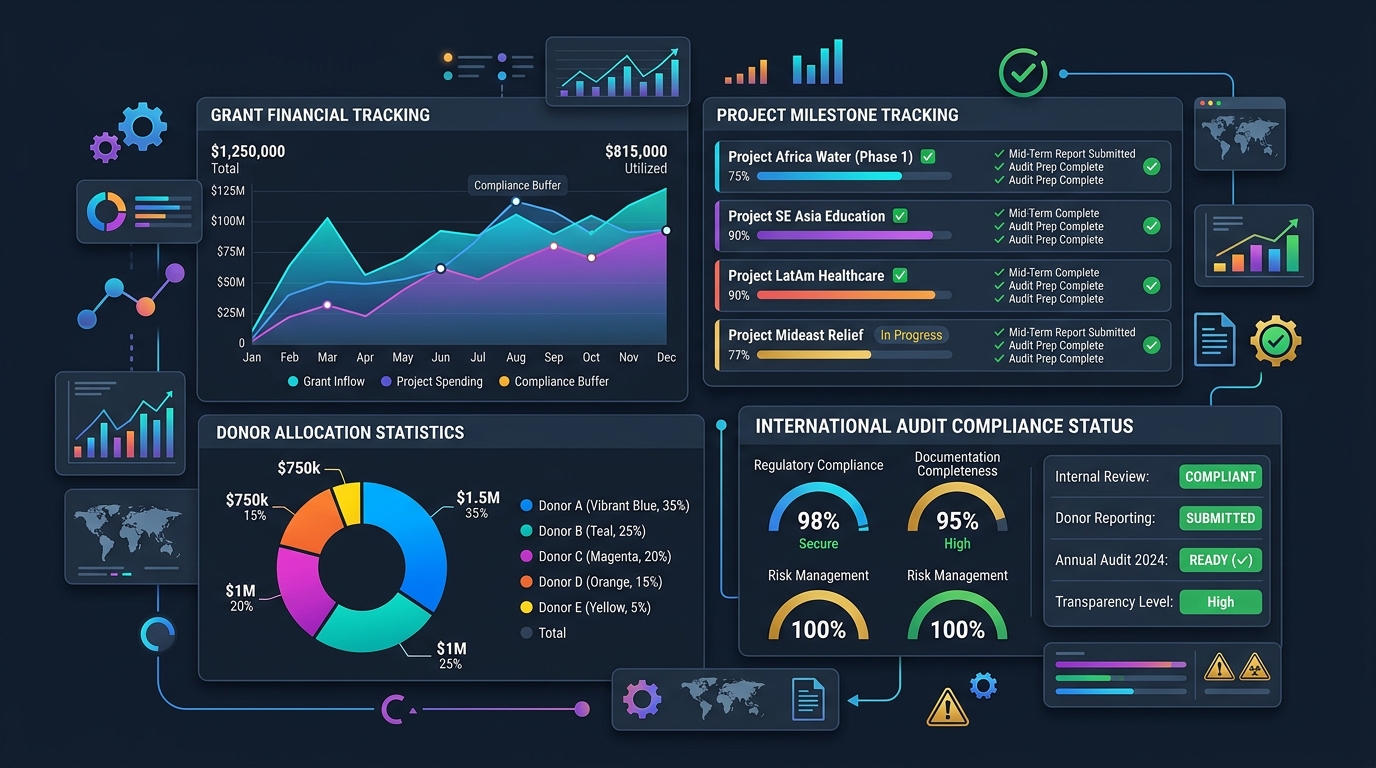
4. Compliance Auditing — Audit-Ready, Every Day of the Year
An NGO audit should not be a crisis. But for organizations running on fragmented systems, it always is — three weeks of frantic data gathering, reconciling mismatched reports, explaining discrepancies.
IBS Management keeps you audit-ready permanently:
- Pre-built compliance reports tailored to common donor frameworks and regulatory bodies.
- Segregation of duties controls — the person who approves a payment cannot be the same person who processes it, built into the system architecture.
- Variance analysis reports — automatically flag any budget line where spending has deviated more than a defined percentage from the plan.
- Board-ready financial summaries — produce clean, professional financial statements for governance meetings without touching a spreadsheet.
- Multi-currency reconciliation — NGOs receive USD, EUR, and GBP grants simultaneously. IBS handles all three with automatic exchange rate management and transparent conversion records.
When an external auditor walks in, your entire financial history is there — organized, consistent, and explainable.
5. Asset Registry — Know What You Own, Where It Is, and What It Is Worth
NGOs accumulate assets: vehicles, laptops, generators, medical equipment, field infrastructure. Over time, without systematic tracking, these assets disappear into organizational fog — misplaced, misused, or simply undocumented at year-end.
IBS Management's integrated asset registry solves this:
- Register every organizational asset with its purchase date, cost, location, assigned user, and depreciation schedule.
- Track asset movement between offices, field sites, and projects.
- Receive maintenance reminders before equipment fails rather than after.
- Generate depreciation reports for accurate financial statements and donor reporting.
- Conduct digital asset verification audits — field staff confirm asset existence from their devices.
For an organization where a stolen laptop or unrecorded vehicle disposal can trigger a donor investigation, this level of visibility is critical.
6. Multi-Project Reporting — One Dashboard, Every Project
The hallmark of a maturing NGO is the ability to run multiple interventions simultaneously — community health in one district, education in another, microfinance in a third — without losing control of any of them.
IBS Management is architected for this:
- Each project has its own dedicated workspace with separate budget codes, expense categories, and reporting timelines.
- Finance teams see all projects in a unified dashboard with drill-down capability into any individual project.
- Program managers see only their project data — relevant, clean, uncluttered.
- Executives get consolidated cross-project reporting with key performance indicators aligned to organizational strategy.
No more emailing project coordinators for updates. No more version-controlled spreadsheets. One system, all projects, complete control.
7. Offline-First Operation — Built for Where NGOs Actually Work
This is the one that most enterprise software gets catastrophically wrong.
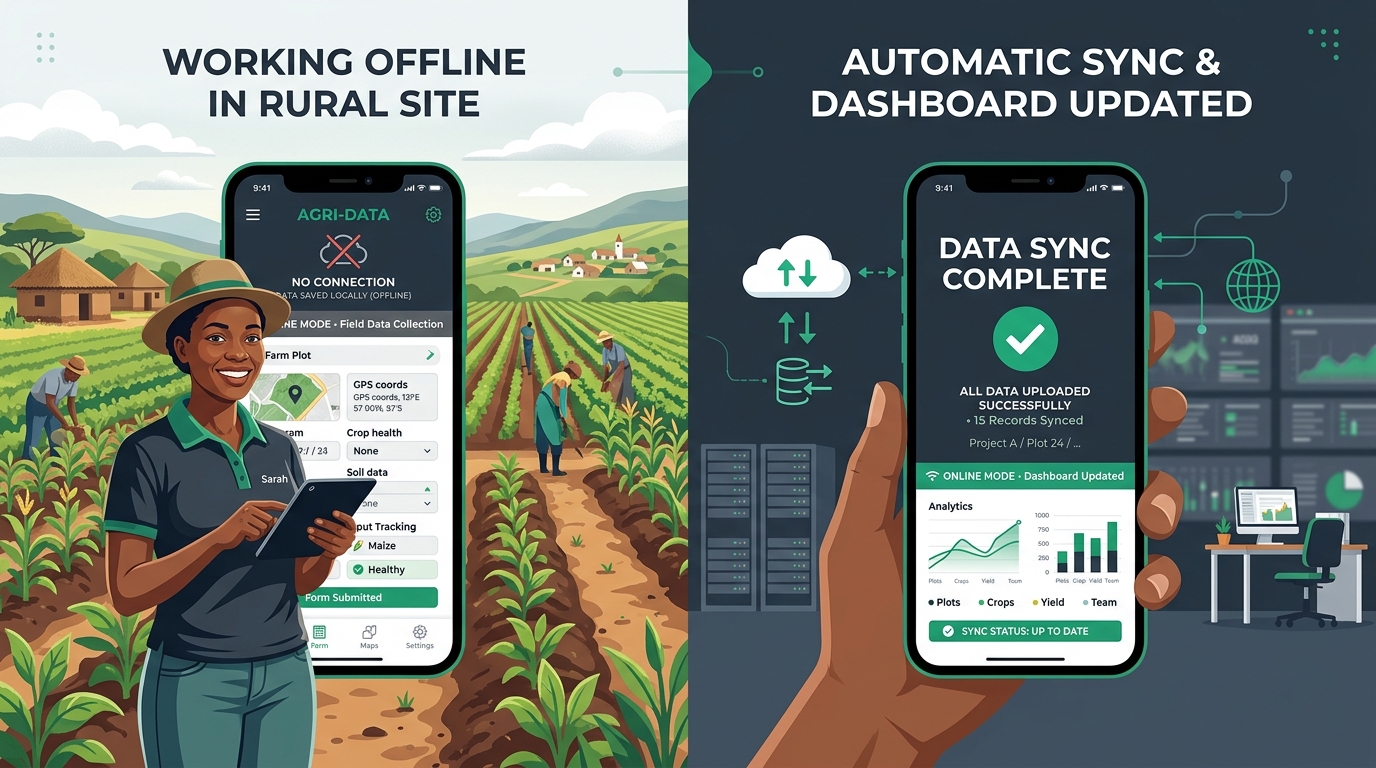
Corporate ERP systems assume reliable, high-speed internet connectivity. NGOs operate in Kayonza, Soroti, Lodwar, and Maiduguri — places where connectivity is inconsistent, expensive, or simply unavailable.
IBS Management works offline by design.
Field officers can record transactions, submit requisitions, and log activities without an internet connection. When connectivity is restored, data synchronizes automatically. There is no data loss, no duplicate entries, no workflow interruptions.
For an NGO running a mobile health clinic in rural Eastern Province, this is not a technical feature. It is the entire value proposition.
8. Role-Based Access Control — The Right People See the Right Things
Not everyone in your organization needs to see everything. A field officer does not need access to payroll. A program coordinator does not need to view donor contract details. A finance officer does not need to approve program activities.
IBS Management's granular role-based access control lets you define exactly:
- What data each role can view, create, edit, or delete.
- Which financial modules each team member can access.
- Which approval workflows each person sits within.
- Which reports each role can generate and export.
This is critical not just for security, but for compliance. Donor contracts often mandate segregation of financial duties, and IBS Management enforces this at the system level — not just on paper.
9. Multi-Currency Support — Because Funding Is Global
Your grants come from Geneva, Washington, London, and Nairobi. Each donor sends money in their home currency. Exchange rate fluctuations affect your project budgets in real time. Manual currency management in spreadsheets is both exhausting and error-prone.
IBS Management handles multi-currency natively:
- Maintain books in your functional currency (RWF, KES, UGX, or any other) while recording grants in their original currencies.
- Apply exchange rates automatically at the date of transaction.
- Generate foreign currency gain/loss reports for accurate financial reporting.
- Reconcile multi-currency bank accounts with full transparency on conversion records.
When Donor A sends EUR and Donor B sends USD, IBS Management keeps them separated, tracked, and accurately reported — automatically.
10. Special NGO Pricing — Because Impact Should Not Be Unaffordable
We believe that organizations doing the most important work in society should not be priced out of the tools they need to do it well.
IBS Management offers a dedicated NGO partnership programme with:
- 75% lifetime discount on standard licensing fees for qualifying registered NGOs and civil society organizations.
- 12-month free trial — run IBS Management in full production for a year before committing. No credit card, no pressure.
- Dedicated implementation support — our team of East African implementation specialists will configure, train, and support your organization through onboarding at no additional cost.
- Data sovereignty — for NGOs with specific data residency requirements, on-premise deployment options are available.
To apply for NGO partnership pricing, contact our team through the IBS Management website. Qualification requires proof of registered NGO status and a brief overview of your operational context.
The IBS Management Difference
There are many software products in the world. Very few were designed with African civil society organizations in mind.
IBS Management was built in Rwanda, by a team of East African technologists who have sat across the table from the same NGO finance managers, program officers, and country directors that you work with every day. We understand M&E frameworks, USAID sub-grant requirements, EU financial reporting standards, and the operational realities of managing multi-donor portfolios in low-connectivity environments — because we have built solutions for exactly these contexts.
Initiative Tech Solutions (ITS) Ltd is headquartered in Kigali at Norrsken House — Africa's largest innovation hub — and our 15-person team includes developers working across the continent. We do not just build software. We build infrastructure for social change.
If your organization is ready to move from spreadsheet chaos to financial clarity, we are ready to help.
Book a free demo today — and discover why the NGOs that matter most are choosing IBS Management.